
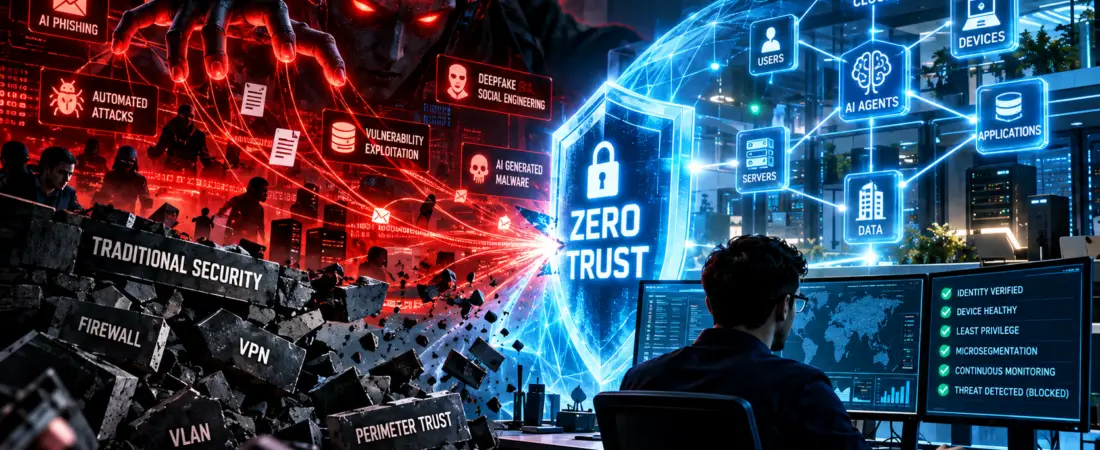
AI Cybersecurity 2026 is changing the way organizations defend their networks. Attackers are using artificial intelligence to automate reconnaissance, social engineering, vulnerability discovery and other stages of cyberattacks.
For years, network security followed a relatively simple idea:
Keep attackers outside the network, and trust what is already inside.
Firewalls protected the perimeter. VPNs connected remote users. VLANs separated departments. Active Directory controlled identities. Network administrators monitored traffic and responded when something looked suspicious.
That model is no longer enough.
In 2026, artificial intelligence is changing the economics of cyberattacks. Attackers can automate reconnaissance, generate convincing phishing content, discover vulnerabilities faster, manipulate users and increasingly coordinate multiple stages of an attack with minimal human intervention.
At the same time, organizations are deploying their own AI assistants and autonomous agents that can access applications, APIs, documents, databases and internal systems.
This creates a difficult security problem:
What happens when the user is trusted, the device is compromised, and the AI agent has permission to act?
This is where Zero Trust becomes much more than a cybersecurity buzzword.
For network administrators, Zero Trust is becoming an operating model for the AI era.

Table of Contents
How AI Cybersecurity 2026 Is Changing the Speed of Attacks
Cybersecurity traditionally depended heavily on the assumption that an attacker needed considerable time and technical expertise to move through an environment.
AI is reducing that friction.
Attackers can use AI to assist with:
- Reconnaissance
- Vulnerability research
- Phishing and social engineering
- Credential attacks
- Malware development
- Infrastructure discovery
- Data analysis
- Automated decision-making
- Lateral movement
- Target identification
Recent 2026 research from SANS found that 78% of surveyed security professionals were already facing AI-enabled attacks, while 63% reported shortcomings in AI threat detection.
Google Threat Intelligence has also reported a shift toward more autonomous attack operations, where AI is increasingly being used for reconnaissance, vulnerability discovery and other operational tasks rather than simply helping an attacker perform research.
The important point for network administrators is not simply that AI can attack networks.
The bigger problem is speed.
If an attacker can automate activities that previously required hours or days, security controls based on periodic reviews and manual investigation become increasingly difficult to maintain.
The Old Network Security Model Is Showing Its Age
Consider a traditional enterprise network:
Internet → Firewall → Core Switch → VLANs → Servers → Users
This architecture can still be useful.
But VLAN segmentation alone does not create Zero Trust.
A user connected to the corporate network may still have access to many resources simply because they are on an approved subnet.
That creates a dangerous assumption:
“Inside the network” does not automatically mean “safe.”
NIST’s Zero Trust Architecture explicitly moves security away from implicit trust based on network location and instead focuses on users, devices, assets and resources. Authentication and authorization should occur before access to enterprise resources is established.
That distinction becomes extremely important in 2026.
An employee’s laptop can be physically inside the office.
The laptop can have a valid IP address.
The user can have a legitimate Active Directory account.
And the endpoint can still be compromised.
Location is not identity.
Zero Trust: Stop Trusting the Network
The rise of AI Cybersecurity 2026 makes continuous verification more important because automated attacks can move faster than traditional security teams can respond.
In the era of AI Cybersecurity 2026, Zero Trust provides a practical framework for controlling access.
The fundamental idea behind Zero Trust is simple:
Never automatically trust a user or device just because it is connected to the network.
Instead, access should be continuously evaluated based on factors such as:
- Who is the user?
- What device are they using?
- Is the device compliant?
- Where is the request coming from?
- What resource are they trying to access?
- What application is making the request?
- Is the behavior normal?
- What level of privilege is required?
- What is the current risk?
NIST’s Zero Trust Architecture (SP 800-207) explains why organizations should move away from implicit trust based on network location.
This changes the role of the network administrator.
The job is no longer simply:
“Keep unauthorized users out.”
It increasingly becomes:
“Make sure every access request is justified, limited and observable.”
AI + Zero Trust: A Necessary Combination
AI creates new attack capabilities, but it can also help defenders.
The rapid evolution of AI Cybersecurity 2026 is also changing how security teams detect and respond to attacks.
A modern security architecture can use AI to analyze enormous volumes of telemetry generated by:
- Firewalls
- Routers
- Switches
- DNS
- VPN gateways
- Identity providers
- Endpoint Detection and Response systems
- Cloud platforms
- Authentication systems
- Network access control
- SIEM platforms
Instead of looking for one suspicious packet, AI can identify behavioral patterns.
For example:
A normal employee might:
Log in → access email → access file server → browse approved applications
But suddenly the same identity:
Logs in from a new location → accesses an unusual server → performs hundreds of DNS queries → attempts privileged authentication → transfers an unusual amount of data
Each individual event might not look catastrophic.
Together, they can indicate compromise.
This is where AI-assisted detection becomes powerful.
But there is an important warning:
AI should not become another blindly trusted component.
The New Security Problem: AI Agents
Traditional cybersecurity mostly focused on protecting humans and machines.
Now organizations are increasingly deploying AI agents.
An AI agent may be allowed to:
- Read documents
- Search internal systems
- Create tickets
- Access APIs
- Query databases
- Modify configurations
- Send messages
- Execute workflows
That creates a new identity category:
Machine-driven identities.
Microsoft’s 2026 Zero Trust guidance specifically highlights the need to apply Zero Trust principles to AI systems and agents, including explicit verification, least privilege and assuming that compromise is possible.
Imagine an AI agent with access to an internal ticketing system.
If that agent is manipulated through a malicious prompt or compromised integration, the attacker may not need to compromise the entire network.
They may simply abuse the permissions already granted to the agent.
That means network administrators need to start asking a new question:
“What is this machine or AI agent allowed to do?”
Not simply:
“Is this machine on our network?”
Recent vulnerabilities also demonstrate why organizations cannot rely on perimeter defenses alone. Our FortiMail CVE-2026-104286 Zero-Day analysis covers an example of an actively exploited security threat.
Least Privilege Becomes More Important Than Ever
Zero Trust is strongly connected with the principle of least privilege.
Users should receive only the access they actually require.
The same principle should apply to:
- Service accounts
- Applications
- APIs
- Network devices
- Automation platforms
- AI agents
- Cloud workloads
Consider an administrator’s workstation.
Does it really need unrestricted access to every server?
Probably not.
Does a monitoring server need access to every application database?
Probably not.
Does an AI support agent need permission to modify firewall rules?
Definitely not—unless there is a specific business requirement with strong controls around it.
Reducing unnecessary permissions reduces the potential blast radius of a compromise.
Microsegmentation: The Network Administrator’s New Weapon
Traditional VLANs are useful, but Zero Trust requires more granular control.
This is where microsegmentation becomes important.
Instead of simply creating:
VLAN 10 → Users
you could build policies around specific resources and communication requirements:
User → DNS: Allowed
User → Internet: Allowed
User → HR Server: Restricted
User → Database: Denied
User → Domain Controller: Only required protocols
Admin Workstation → Network Devices: Management protocols only
IoT Device → Internet: Restricted
IoT Device → Internal Servers: Denied
The objective is simple:
If one endpoint is compromised, the attacker should not automatically inherit the entire network.
CISA describes microsegmentation as an important Zero Trust capability because it can reduce attack surface, limit lateral movement and improve visibility.
For network administrators, this is one of the most practical areas to start.
Your Firewall Is Still Important — But It Is Not Enough
Zero Trust does not mean throwing away your firewall.
Firewalls remain essential.
A modern enterprise environment may still require:
- Next-generation firewalls
- IDS/IPS
- VPN or ZTNA
- DNS security
- Network Access Control
- Endpoint security
- Identity security
- SIEM
- Network monitoring
- Microsegmentation
- Secure web gateways
The difference is how these technologies work together.
Instead of:
Firewall = Security
the architecture becomes:
Identity + Device + Application + Network + Data + Behavior + Policy
working together.
This is a much stronger security model.
Network infrastructure itself can also become an attack target. See our analysis of Critical Cisco NX-OS Vulnerabilities in October 2026 for an example of why network administrators must treat infrastructure security as a priority.
What Network Administrators Should Change in 2026
For network administrators, AI Cybersecurity 2026 means combining traditional network controls with identity, device posture, behavioral analytics and Zero Trust policies.
Zero Trust does not need to be implemented overnight.
A practical migration can happen gradually.
1. Start With Identity
Review:
- Active Directory
- Entra ID or other identity platforms
- Privileged accounts
- Service accounts
- Shared accounts
- MFA
- Dormant accounts
- Administrative privileges
Remove unnecessary privileges.
A compromised administrator account can be far more dangerous than a compromised workstation.
2. Know Every Device
You cannot protect devices you cannot identify.
Maintain visibility of:
- PCs
- Laptops
- Smartphones
- Tablets
- Printers
- IP phones
- Access points
- Servers
- IoT devices
- Network appliances
Unknown devices should not automatically receive trusted network access.
3. Segment the Network
Start with logical separation.
For example:
VLAN 10 — Corporate PCs
VLAN 20 — Wireless Devices
VLAN 30 — Mobile/Guest Devices
VLAN 40 — Servers
VLAN 50 — Network Management
VLAN 60 — IoT
But remember:
VLANs provide segmentation. Zero Trust provides policy-driven trust decisions.
Do not confuse the two.
4. Protect Management Interfaces
Network administrators should pay particular attention to management access.
Protect:
- SSH
- HTTPS
- SNMP
- RDP
- WinRM
- Network controllers
- Firewall management
- Switch management
- Router management
Management interfaces should never be casually reachable from every user subnet.
Create dedicated management networks and restrict administrative access.
5. Monitor Behavior, Not Just Availability
Traditional NMS tools answer questions like:
Is the switch up?
Is the interface down?
Is CPU usage high?
Security requires additional questions:
Who is communicating with whom?
Is this traffic normal?
Why did this workstation suddenly contact a server it has never contacted before?
Why did this account authenticate from two unusual locations?
Why is an IoT device communicating with a database?
This is where network telemetry, SIEM, flow monitoring and behavioral analytics become extremely valuable.
6. Treat DNS as a Security Control
DNS is often overlooked.
Every application needs to resolve something.
Attackers know this.
A modern security architecture should monitor:
- Newly registered domains
- Suspicious DNS requests
- Malware-related domains
- DNS tunneling indicators
- Unusual query volumes
- Known malicious infrastructure
A secure DNS layer can become an important early-warning mechanism.
7. Assume Breach
Perhaps the biggest mental change for network administrators is this:
Do not design the network assuming that nothing will be compromised.
Design it assuming something eventually will be.
That changes architecture.
Instead of asking:
“How do we stop every attack?”
ask:
“If this PC is compromised, how far can the attacker go?”
Then:
“If this account is stolen, what can it access?”
And:
“If this server is compromised, what prevents lateral movement?”
That mindset is at the heart of Zero Trust.
NSA guidance released in October 2026 similarly emphasizes assuming adversarial compromise and continuously verifying users, devices, workflows and communications.
The Future Network May Not Look Like a Network
This is perhaps the most interesting change happening in enterprise security.
In the past, network administrators thought primarily in terms of:
IP → VLAN → Firewall → Route → ACL
The future requires thinking in terms of:
Identity → Device → Application → Resource → Risk → Policy → Action
The IP address will still matter.
Routing will still matter.
Switching will still matter.
Firewalls will still matter.
But identity and context will increasingly determine what the network allows.
Google’s 2026 “Beyond Zero” work describes an evolution toward authorization at the level of individual actions and resources, including interactions involving APIs and AI agents.
That points toward a future where access decisions become increasingly granular and dynamic.
A Practical Zero Trust Blueprint for Network Administrators
A practical architecture could look like this:
                     INTERNET
                         |
                  [ NGFW / SASE ]
                         |
                [ Zero Trust Layer ]
                         |
          +--------------+--------------+
          |              |              |
       Identity        Device         Risk
       Provider       Posture        Engine
          |              |              |
          +--------------+--------------+
                         |
                 [ Policy Engine ]
                         |
        +----------------+----------------+
        |                |                |
     Users            Servers          AI Agents
        |                |                |
     Limited          Limited          Limited
     Access            Access            Access
        |                |                |
        +----------------+----------------+
                         |
                  [ Monitoring / SIEM ]
                         |
                    SOC / Admin
The important part is not the specific vendor.
The important part is the architecture.
No identity gets unlimited trust.
No device gets unlimited trust.
No application gets unlimited trust.
No AI agent gets unlimited trust.
What This Means for the Network Administrator’s Career
Zero Trust is also changing the skill set expected from network professionals.
Knowing Cisco CLI, routing, switching, OSPF, BGP, VLANs and firewalls remains valuable.
But modern network engineers increasingly need knowledge of:
- Zero Trust Architecture
- IAM
- MFA
- NAC
- SASE
- ZTNA
- Microsegmentation
- SIEM
- EDR/XDR
- Cloud networking
- API security
- Network telemetry
- AI security
- Automation
- Policy-based access control
The future network administrator is becoming something closer to a:
Network + Security + Identity + Automation Engineer.
That is a significant career opportunity.
The Biggest Mistake to Avoid
The biggest mistake organizations can make is buying a Zero Trust product and assuming Zero Trust has been implemented.
Zero Trust is not a box.
It is not a firewall feature.
It is not a VPN replacement.
It is not a single software product.
It is an architecture and security philosophy built around:
Verify explicitly.
Use least privilege.
Assume breach.
And in an AI-driven environment, these principles become even more important.
As AI Cybersecurity 2026 continues to evolve, organizations will need security architectures that can adapt to both human users and autonomous AI systems.
Final Thoughts
AI is not going to replace the network administrator.
But it is changing what the network administrator must protect.
The network is no longer just connecting humans to applications.
It is connecting:
Humans + Devices + Cloud Services + APIs + Workloads + AI Agents.
Every new connection creates another potential trust relationship.
And attackers are becoming faster at exploiting those relationships.
That is why Zero Trust is becoming increasingly important in 2026.
The question for network administrators is no longer:
“Is this device inside my network?”
The better question is:
“Why should this device, user or AI agent be allowed to access this resource right now?”
That single question represents the shift from traditional network security to modern Zero Trust security.
And for organizations preparing for the next generation of cyber threats, that shift cannot come soon enough.